

Heat seal testing
Heat seal testing is carried out to verify and optimise sealing processes under production-relevant and controlled conditions. Materials are evaluated using controlled and repeatable test setups, enabling precise analysis of how they respond to temperature, pressure, time and cooling.
Testing goes beyond theoretical calculations. By working directly with the material in practice, the effective sealing window can be identified and validated before machine commissioning or process changes are introduced.
The purpose of testing is not to simulate a complete packaging machine cycle, but to define the sealing conditions under which stable production can be achieved.
What is evaluated during testing?
During testing, materials are exposed to clearly defined process conditions to evaluate:
- Optimal sealing temperature range
- Required sealing force for consistent contact and fusion
- Minimum and maximum sealing time
- Cooling behaviour and release temperature
- Seal strength, appearance and repeatability
The interaction between parameters is analysed to ensure stable seals without shrinkage, deformation or material damage.
Why testing matters
Even materials that appear identical on paper can behave very differently during sealing. Small variations in polymer formulation, layer structure, coatings or thickness can significantly influence the final seal.
Structured testing makes it possible to:
- Identify process limits at an early stage
- Define a stable and repeatable sealing window
- Reduce risk during commissioning and ramp-up
- Minimise adjustments, scrap and downtime in production
From test results to a production-ready process
Test results form a solid foundation for:
- Final definition of sealing parameters
- Selection of sealing components and system configuration
- Validation of process stability prior to production start
By verifying the sealing process under defined and reproducible conditions, uncertainties are removed before the system goes into operation.
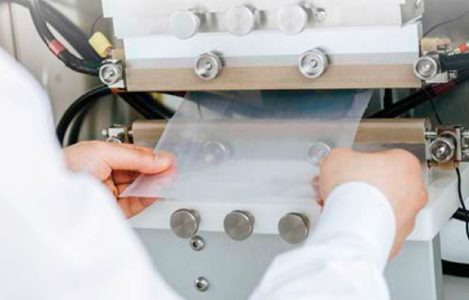
Customer benefits of testing before and during start-up
Testing the sealing process before and during machine start-up provides a clear advantage. Instead of relying on assumptions or trial-and-error in production, the process is validated from the outset.
Defining the optimal sealing window in advance reduces commissioning time and allows stable production to be reached faster. Verified parameters minimise adjustments during start-up and ensure consistent seal quality from the very first production run.
Early testing significantly reduces production risk. Potential issues related to material behaviour, cooling performance or cycle time are identified before they impact output, helping to avoid scrap, unstable seals and unexpected downtime during ramp-up.
Testing during start-up also enables fine-tuning under real operating conditions. Small material variations can be compensated immediately, cooling and release behaviour can be optimised at actual machine speed, and parameter changes are validated directly. This ensures a smooth transition from commissioning to stable, repeatable production.
Validated sealing parameters also reduce material waste, limit unnecessary stress on sealing components and lower total cost of ownership. When production volumes increase or speeds are raised, a tested and documented sealing process provides confidence that quality will remain stable.
The Vinther & Strand approach
Reliable heat sealing starts with understanding how material behaviour and process parameters interact in practice. That is why testing is an integral part of our application work.
We focus on defining the right sealing technology, configuration and parameters to meet the customer’s performance requirements — ensuring consistent seal quality, reduced scrap and a stable, production-ready sealing process from day one.